UEC Holders Can Apply for CLP Examination— LPQB’s Decision Relieved Dong Zong  

UEC Holders Can Apply for CLP Examination— LPQB’s Decision Relieved Dong Zong  

Statement Released by Dong Zong

December 20, 2017

UEC Holders Can Apply for CLP Examination

LPQB’s Decision Relieved Dong Zong


Through various channels, Dong Zong was informed of the decision of the Legal Profession Qualifying Board (henceforth LPQB) to continuously let UEC holders sit for the Certificate in Legal Practice (henceforth CLP) examination. In regard to this, Dong Zong comments as follows:


(1) Dong Zong had separately written to the LPQB on 23 and 30 November requesting a meet-up to find out the reason of revoking the requirements of the UEC and SPM as prerequisites to sit for the CLP examination. Administrators from Dong Zong simultaneously had met the president of the Malaysia Bar Council Mr George Varughese on 8 December and submitted some data on “UEC holders passing the CLP examination” to reflect the reality.


Attributed to the fact that many UEC holders had successfully sat for as well as passing the CLP examination with UEC certificate and SPM certificate and turning eventually into practicing advocates and solicitors, we wish to convey our appeal through Mr George Varughese urging the LPQB to revoke their decision and let UEC holders sit for the CLP examination using the UEC certificate and SPM certificate as prerequisite requirement.


(2)  As updated by the president of Malaysia Bar Council Mr George Varughese, before 23 September 2005, all UEC holders applying for CLP examination must have the UEC certificate plus the SPM or STPM certificate and LLB (Bachelor of Law). To unify requirements to sit for the CLP examination as a practice, the LPQB had made adjustment and thus MICSS candidates sitting for the CLP examination must have (1) UEC certificate plus two credits in STPM/A Level; or (2) SPM certificate plus two credits in STPM/A Level.


In the capacity of president in the Malaysia Bar Council, Mr George Varughese is the ex-officio member of the LPQB. On 8 December, Mr George Varughese had promised to convey Dong Zong’s request in their impending board meeting to be held on 19 December to postpone the decision revoking all UEC holders to sit for the CLP examination in 2005.


In the meantime, Dong Zong had simultaneously written to all MICSS principals to collect and provide the information of UEC holders attending LLB currently on 22 November. Besides, Dong Zong likewise organised a forum on 12 December inviting advocates and solicitors, including affected students and parents to collect relevant information for further negotiation with the LPQB. In addition, Dong Zong also submitted a memorandum to the LPQB which attached information on the standard of the UEC urging the LPQB to revoke their decision accordingly on 18 December.


As it goes, Dong Zong has hitherto collected the information of 33 successful UEC holders sitting for the CLP examination of which 16 had become practicing advocates and solicitors. For the time being, 143 UEC holders are reading the LLP programmes or in the process of sitting for the CLP examination.


Dong Zong is indebted to Malaysia Bar Council president Mr George Varughese for his full support in conveying its views during the December 19 LPQB board meeting. Similarly, Dong Zong also would like to acknowledge all independent Chinese secondary schools, practicing advocates and solicitors, current LLB students and parents, etc. for their help in the provision of information, opinions and relevant matters during this indecisive period. Besides, Dong Zong will keep in touch with the LPQB for further updates on the development.

UEC Holders Can Apply for CLP Examination— LPQB’s Decision Relieved Dong Zong  

MICSS History Coursebooks Are Relevant to International History Education Trend

Statement Released by Dong Zong

December 12, 2017

MICSS History Coursebooks Are Relevant to International History Education Trend


In respect of the Deputy Minister of Education Datuk Chong Sin Woon’s statement that it is beyond reproach to request the increase of proportion in local history in MICSS curriculum as one of the requirements thus to recognise the UEC as “not any one country will allow their students to study more world history than its own”, Dong Zong herewith responds as follows:


(1) Currently, the weightage of junior level History and World History in MICSS curriculum is 53.73 percent and 46.27 percent respectively and it belies what Datuk Chong has claimed, viz., local history in MICSS curriculum is less than one thirds of its contents.


(2) At senior level, there are three History coursebooks employed in MICSS curriculum: Malaysia and Southeast Asia History, China (renamed East Asia History in 2020) and World History. In actual fact, the redaction and compilation of these coursebooks are in consonance with the trend of international History education. Accordingly, lower level History coursebook emphasises on local history, whereas higher level History covers periphery regions and World History aiming to concurrently nurture nativeness and world view. Take the coursebooks used in Singapore, China and Australia as examples, it is evident that in Singapore History coursebooks, histories of Southeast Asia, India and China are warranted and half of their contents are history of the world; whereas there are six topics in China History coursebooks, three of them are Ancient History of the World, Modern History and Contemporary History. In Australia, the major task of elementary History coursebook is to teach about local history while from junior level onwards the contents are almost entirely about world histories.


(3) As revealed by pundits in 2011, only 20 percent of world histories and histories of other countries are found in the SPM History curriculum. Obviously, this approach is against international History education trend and in actual fact inadvisable. As such, Dong Zong opines, the government’s directive to amend MICSS History curriculum is an ignorable move towards the History profession as it defies international trend and thus unacceptable totally.

UEC Holders Can Apply for CLP Examination— LPQB’s Decision Relieved Dong Zong  

The Budget 2018 Is One of Unoriginal— Dong Zong Laments over the Run-of-the-mill Budget

Statement Released by Dong Zong

October 28, 2017

The Budget 2018 Is One of Unoriginal—

Dong Zong Laments over the Run-of-the-mill Budget


With respect to the unoriginal Budget 2018 submitted in the House of Representatives by the Prime Minister cum Finance Minister Mohammad Najib bin Tun Haji Abdul Razak, Dong Zong sorely regrets and is disappointed hereat, a responsive statement is thus forwarded:


(1) Dong Zong understands that all types of schools in the country are precious resources and preponderances as they contribute profusely in nurturing polymaths as well as upholding prosperity and advancement for the country. To our great regret, the Budget 2018 is one of unoriginal in terms of increase in appropriation for Chinese vernacular schools, etc. and it continues “skipping” appropriation for national-type secondary schools, including independent Chinese secondary schools.


(2) In the Budget 2018, RM 550 million is appropriated for the promotion and maintenance of seven types of schools. Of which, national primary schools are allocated 250 million, yet Chinese and Tamil vernacular schools, Catholic schools, full-boarding schools, government-funded religious schools, MARA Junior Science Colleges are each appropriated 50 million respectively.


(3) Records show that in both the Budget 2012 and 2013, a special funding of RM 100 million is appropriated to Chinese vernacular schools annually, yet the Budget from 2014 to 2018, merely RM 50 million is appropriated (see attached Table 1). In actuality, the appropriation distributed to Chinese vernacular primary schools has never been sufficient and just. With the acceleration of inflation, the meagre sum Chinese vernacular schools received cannot satiate their developmental needs and hence fund-raising events are staged constantly.


(4) Over time, it is a normalcy that Chinese independent secondary schools are not appropriated in the Budget pronounced every year. As such, Dong Zong had submitted a memorandum of understanding to the Malaysia Chinese Association, urging the alliance government to appropriate the least a total of RM85 million to all 60 Chinese independent secondary schools in the country, taking a RM1,000 allowance for each MICSS student as appropriation base. To our regret, in the Budget 2018 newly pronounced, as anticipated, no appropriation was budgeted to all the 60 independent Chinese secondary schools.


(5)  Let alone there was appropriation given to reformed secondary schools (national-type secondary schools) in 2016, record shows in the Budget from 2012 to 2015, no special appropriation was allocated. Though after some efforts, in the Budget from 2012 to 2015 and 2017, appropriation was incorporated to national-type secondary schools as wished. Yet in the Budget 2018, the government’s former practice re-dominates and eventually no special appropriation was given to all national-type secondary schools.


(6) In view of the inconsistency, we earnestly hope the government will redress the practice., viz., to appropriate fairly to institutions inclusive of Chinese vernacular schools, independent Chinese secondary schools and national-type secondary schools, etc. Moreover, we wish the government will complete releasing the monies to the schools in the first half year so as to avoid serious impacts incurred due to delays in appropriation.


Table 1: Special Appropriation in the Budget from Year 2012 to 2018 (in RM)

Year SMK SMJK (Chinese) SMJK (Tamil) National-type Secondary

Schools

Catholic Secondary

Schools

Full Boarding Schools Government-funded Religious Schools MARA Junior Science Colleges


Private Religious Schools Total
2012 500 million 100 million 100 million No appropriation formerly, finally 20 million allocated 100 million 100 million 100 million 1 billion + 20 million
2013 400 million 100 million 100 million No appropriation formerly, finally 30 million allocated 100 million 100 million 100 million 100 million 1 billion + 30 million
2014 100 million 50 million 50 million No

appropriation formerly, finally 15 million allocated

50 million 50 million 50 million 50 million 50 million

(People’s Religious Schools)

450 million + 15 million
2015 450 million 50 million 50 million 25 million 50 million 50 million 50 million 50 million 25 million 800 million
2016 No appropriation pronounced formerly. The appropriation allocated to SMJK (Chinese), SMJK (Tamil), Catholic Secondary and National-type Secondary was released only a year later, i.e. 2017. 500 million
Not Known 50 million 16.5 million 15 million 16.5 million Not Known Not Known Not Known Not Known
2017 250 million 50 million 50 million No appropriation formerly, finally 15 million allocated 50 million 50 million 50 million 50 million 50 million 600 million + 15 million
2018 250 million 50 million 50 million 50 million 50 million 50 million 50 million 550 million

Notes:

1. Budget 2012: six types of schools received a special appropriation totalled RM1 billion. National primary schools received RM500 million; whereas SMJK (Chinese), SMJK (Tamil), Catholic schools, government-funded religious schools and MARA junior colleges received RM100 million each.

2. Budget 2013: seven types of schools received a special appropriation totalled RM1 billion. National primary schools received RM400 million; whereas SMJK (Chinese), SMJK (Tamil), Catholic schools, government-funded religious schools, full-boarding schools and MARA junior colleges received RM100 million each.

3. Budget 2014: eight types of schools received a special appropriation totalled RM450 million. National primary schools received RM450 million; whereas SMJK (Chinese), SMJK (Tamil), Catholic schools, full-boarding schools, MARA junior colleges, government-funded religious schools and people’s religious schools received RM50 million each.

4. Budget 2015: nine types of schools received a special appropriation totalled RM800 million. National primary schools received RM450 million; whereas SMJK (Chinese), SMJK (Tamil), Catholic schools, full-boarding schools, government-funded religious schools and MARA junior colleges received RM50 million each. Private religious schools (registered) and national-type secondary schools received RM25 million each.

5. Budget 2016: nine types of schools received a special appropriation totalled RM500 million. National primary schools, SMJK (Chinese), SMJK (Tamil), Catholic schools, full-boarding schools, government-funded religious schools, MARA junior colleges, private religious schools (registered), and national-type secondary schools were appropriated respectively but no figures were disclosed.

6. Budget 2017: eight types of schools received a special appropriation totalled RM600 million. National primary schools received RM250 million; whereas SMJK (Chinese), SMJK (Tamil), Catholic schools, full-boarding schools, government-funded religious schools, private religious schools (registered) and MARA junior colleges received RM50 million each.

7. Budget 2018: seven types of schools received a special appropriation totalled RM550 million. National primary schools received RM250 million; whereas SMJK (Chinese), SMJK (Tamil), Catholic schools, full-boarding schools, government-funded religious schools and MARA junior colleges received RM50 million each.

UEC Holders Can Apply for CLP Examination— LPQB’s Decision Relieved Dong Zong  

The Relocation Expenses of SMJK Confucian Should Be Shouldered by the Government

Statement Released by Dong Zong

June 22, 2017

The Relocation Expenses of SMJK Confucian Should Be Shouldered by the Government


Herewith, Dong Zong posits its stance in regard to the campus dispute between Confucian Private High School and SMJK Confucian proper:


1. As indicated evidently by extant documents and the land grant of Confucian Private High School, the ownership of the school land of the sharing two schools is entitled to Confucian Private High School. Over the past decades, there was not any land ownership disputes between Confucian Private High School and SMJK Confucian. As such, the raise of the dispute at this juncture is indeed incomprehensible. Dong Zong opines that there should not be any disputes over the land ownership and it ought to halt right there and no one should instigate further unnecessary disputes.


(2) SMJK Confucian had been over the years applied to move out of its current location for further development and was granted in 2004 by the Ministry of Education. With responses from various sectors, a number of lands were offered freely by developers, of which the most impressive ones were the 4-acre land offer in Seri Kembangan in 2007 and the10-acre land offer in 2013 at Rawang. Unfortunately, these offers were all gone with the wind attributed to a variety of factors. The most unfortunate being, the relocation issue of SMJK Confucian had constantly be raised prior to national election and was later put aside thus the matter is unsettled until this very day. The reason of its delay in relocation is hitherto unrevealed.


(3) In response to the said dispute, Dong Zong urges the School Board of SMJK Confucian to withdraw its lawsuit against Confucian Private High School over the land dispute immediately and fulfilled its relocation plan as soon as possible for the advancement of the two schools at longer term. Dong Zong opines that matters pertinent to Chinese community need not be forwarded to the court as it consumes resources from the community; rather, it should be negotiated and compromised privately.


(4) The land dispute between the mentioned two schools will subsequently lead to an internecine situation and is destructive to Chinese education. Both schools share a campus area of 2.3 acres and accommodate some 3,000 students in capacity. Their campuses are indeed overpopulated which backfires further development and is inconducive to learning. That said, we believe that negotiation should be at play to settle the problems encountered by the relocation of SMJK Confucian. Further, we also reckon the government is obliged to honour its promises towards national-type Chinese schools after directing them to reform by shouldering the expenses of land, construction and facilities to assure its earlier relocation.

UEC Holders Can Apply for CLP Examination— LPQB’s Decision Relieved Dong Zong  

SMJK (Chinese) School Boards’ Responsibilities Reminded to Face Squarely— Speedy Settlement of School Land Entitlement Urged

Statement Released by Dong Zong

April 13, 2017

SMJK (Chinese) School Boards’ Responsibilities Reminded to Face Squarely

Speedy Settlement of School Land Entitlement Urged


With respect to the dispute generated by the school land of SJK(C) Yeok Kheong Selama as well as the fact that the land entitlements of many Chinese vernacular schools are owned by irrelevant individuals, it is foreseen severe impact will ensue towards the schools when these individuals reclaim the land through litigation anytime in the future, Dong Zong hereby comments as follows:


(1) Dong Zong expresses its acknowledgement towards those distinguished predecessors who had selflessly donated pieces of lands adhering the principle “notwithstanding poor, education should not be neglected” for the construction of Chinese schools. This seminal philanthropy has inevitably gained reverence and respect from the general public. Unfortunately, if these philanthropic acts in the form of land donation are not settled appropriately, such as in black and white and legalised properly, say after a number years when the donor’s descendants defy their ancestor’s will and resort to litigation reclaiming the relevant lands, disasters may occur as it harms Chinese education and brings about negative impacts towards students. As this internecine situation is the least expected, Dong Zong regrets the possible proceedings.


Sensing the severity, Dong Zong urges the two relevant parties involved in the SJK(C) Yeok Kheong Selama issue to take will fulfillment and Chinese education as priorities; as it proceeds, the school board needs to initiate negotiation with the other party frankly and responsibly thus to settle the dispute appropriately with fair, reasonable and legal approach.


(3) We understand that under the National Education Act, Chinese vernacular schools being government funded schools, the powers and rights endowed towards their school boards are clear and succinct. That explained why school boards are revered as the “babysitters” of Chinese education. The three prominent characteristics of any one Chinese vernacular school are (1) the rights owned by its school board, (2) its teaching and (3) employing Chinese as its medium of instruction. That said, it in actual fact embodies the critical role school board plays in the school. Each and every school board of Chinese vernacular school needs to fulfill the duties and responsibilities mandated by the Education Act and Chinese community in terms of establishment, management, maintenance and development. The members of the school board hence need to constantly remember and remind themselves on how to effectively execute the power of the school board.


We wish that every member of the school boards of Chinese vernacular schools will be well informed of her/his responsibilities given and proactively act, and carry out her/his powers and duties on all relevant matters, inclusive of the registration of Board of Directors, proper management of the school’s properties and monies as well as solving the problem of land entitlement and land tax.


(3) We also hope that all school boards of Chinese vernacular schools will immediately examine their land grant and land tax document to ensure who the registered owner is and the land tax paid receipts and land donation documents. As for those vernacular schools whose land belongs to individual, the state government or commercial enterprises, the school boards should seek to transfer the entitlement to the guarantors of the school board or non-profit limited companies owned by the Board of Directors; whereas for others whose land belongs to association or religious organisation—albeit some are the establishment body of the schools yet others are not—the school boards need to approach them and settle the entitlement status fairly and reasonably once and for all.

UEC Holders Can Apply for CLP Examination— LPQB’s Decision Relieved Dong Zong  

Calling up for Cross Racial Expanded Conference on the UEC Recognition

Statement Released by Dong Zong

April 4, 2017

Calling up for Cross Racial Expanded Conference on the UEC Recognition


Dong Zong herewith releases this statement with reference to the absurd and unfounded allegations raised by Parti Bumiputera Perkasa Malaysia in their round table meeting entitled “Controversy of the UEC” asserting they are against the official recognition of the UEC:


1. We understand under the Education Act, all vernacular schools are granted the rights to exist respectively; parents are allowed to send their children to whichever vernacular school they willed and nobody is allowed to intentionally corelate patriotism with their choice. According to the Federal Constitution article 152, in the process of according Bahasa Melayu as the national language, other ethnic groups are granted the right to learn, use and develop their own mother tongue and this is an unanimously agreed right under the independence agreement and should not be infringed. From prior to earning her independence till an independent nation now, all vernacular schools have been coexisted harmoniously in Malaysia; in this vein, the official recognition and acceptance of the UEC does not in any way go against the constitutional spirit and principle which might harm the official status of Bahasa Melayu.


We posit, Malaysia independent Chinese secondary schools (henceforth MICSS) enjoy their legal status in the Education Act and it is unchallengeable under the law; the Education Act endows parent and their children to freely choose, including the right to study in independent Chinese secondary school and no one can in any way questions, denies and exploits their right. Evidently, any one country which is responsive to the open and multiplicity trend of the world education will prosper continuously; in contrary, isolated, narrow-minded and unitary views and behaviours contribute to backwardness.


2. We regret some organisations and individuals are making blocking and extremist comments against independent Chinese secondary schools which are absurd and unwarranted though they hardly know what the UEC and Malaysia Independent Chinese Secondary Schools are. As such, we conclude them incorrect and irrational in response towards both the UEC and independent Chinese secondary schools.


3. We reiterate, the MICSS unified curriculum is relevant and responsive to the multiple needs of our country which refers to the international secondary curriculum in formulation and redaction as well as observing and taking the national curriculum as the blueprint. Simply put, spiritually, localisation and multiplicity are embedded in the MICSS unified curriculum; whereas in terms of contents, the priority goes to the nurture of patriotism and cosmopolitan view, as well as taking competences like morality, intelligence, physical health, teamwork and aesthetics into account for the production of all rounding polymaths.


In the meantime, Bahasa Melayu as a subject has never been neglected in the MICSS unified curriculum over the years and has been revered as the national language. Therefore, any rebuke alleging that MICSS unified curriculum disarrays the national education is a false and unfounded assertion.


4. To make MICSS unified curriculum and the UEC more intelligible to the general public, Dong Zong will soon co-organise a cross racial expanded UEC conference with major education organisations inviting pundits and scholars, education organisations, representatives from Chinese community and all political parties to collect objective views based on reality and evidence specifically. We are convinced, through rational discussions and exchanges, the extant academic values and contributions of the UEC will be asserted and focused.

UEC Holders Can Apply for CLP Examination— LPQB’s Decision Relieved Dong Zong  

MICSS Curriculum Accords Multiplicity Reality— There is No Excuse for the UEC Recognition Officially

Statement Released by Dong Zong

March 15, 2017

MICSS Curriculum Accords Multiplicity Reality—

There is No Excuse for the UEC Recognition Officially


Apropos what the Minister of Higher Education Idris bin Jusoh had informed in response to the Member of the Parliament for Gerik constituency Hasbullah bin Osman’s question, five reasons are provided as intrinsic basis for the Ministry of Higher Education to reject UEC holders for entry into national universities, Dong Zong herewith responds as follows:

1. Dong Zong reiterates, the MICSS unified curriculum is formulated and designed attuned to the multiplicity reality of the country as well as the latest international secondary education curriculum standard. The MICSS unified curriculum, including the History subject, observes and adapts the national curriculum as blueprint in the process of formulation. Further, it also fully embodies localisation and pluralism, let alone domestic and world view embedded. The nurture of patriotism is highlighted and competences like morality, intelligence, physical health, teamwork and aesthetics are focused to meet the country’s multiplicity reality.


We wish to remind all relevant parties to look into the matter seriously, viz., to review the national History coursebooks used for several years now in vernacular schools which we thought disarray our country’s multiplicity reality yet side a particular ethnic group and religion in a narrow-minded and unitary historical view. We strongly believe these weaknesses need to be redressed imminently. As such, we insist no compromising amendment on MICSS unified curriculum to be made congruent with the SPM History curriculum standard though it is an additional prerequisite for the UEC recognition.


2. As a matter of fact, Dong Zong delegates had once discussed with the then Education Minister Mahdzir Bin Khalid at the parliament in 2015 and he consented to arrange a three-party talk among the Education Ministry, Ministry of Higher education and Dong Zong for the official recognition of the UEC. Later, follow-up letters were posted to both the Ministry of education and Ministry of Higher Education by Dong Zong yet hitherto no reply is received. We thus urge the government to face up the matter positively and hold the meeting as consented earlier and not to delay time and again by making statement via newspapers or the parliament telekinetically.


3. As clearly stated in the general order issued by the Private Higher Education Institutions Registrar on 19 March 2004, the Ministry of education had decided to allow UEC holders to be admitted for private university but not national universities, including TAR College (upgraded to university college in 2013) and likewise non applicable to the enrollment of national university curriculum run in private universities. Yet on the TAR College official website it is posted that UEC is one of the requirements eligible for application to its Bachelor degree programmes. Unsure and confused, we urge both the Ministry of Higher Education and the TAR College to make immediate confirmation on the matter.


4. We solemnly posit, on the matter of the UEC recognition, the government in a word is not rendering a truth seeking and vigour attitude. Academic aspect is not mooted in the UEC recognition; rather, political spin and tactics are employed and thus the responses were all deviation and reiteration filled with excuses of all sorts for the UEC recognition; worse still, more additional requirements are introduced. In actual fact, the Chinese community is greatly disappointed with the perfunctory replies which carries no sincerity but teasing diversion given by the government.

Warmly Welcome the Delegation of YB Tan Sri Datuk Seri Panglima Haji Annuar bin Musa to Dong Zong. Speech by Temenggong Dato Vincent Lau Lee Ming, Chairman of Dong Zong

Warmly Welcome the Delegation of YB Tan Sri Datuk Seri Panglima Haji Annuar bin Musa to Dong Zong. Speech by Temenggong Dato Vincent Lau Lee Ming, Chairman of Dong Zong

Date:           7 February 2017 (Tuesday)

Time:          10.30am

Venue:        Meeting Room A401, Dong Zong


Umno Information Chief YB Tan Sri Annuar Musa and your delegation,

Malaysian People’s Movement Party Vice President Datuk Dr. Dominic Lau and members,

Central Committee of Dong Zong and administrative staff of Dong Zong,


Good morning to all of you.


First and foremost, on behalf of Dong Zong, I wish to extend a very warm welcome to YB Tan Sri Annuar Musa and your delegation to visit Dong Zong. I also welcome Datuk Dr. Dominic Lau and your party members. Thank you all for taking time to meet with us this morning. The visit by YB Tan Sri today is to know more about the Chinese education in this country.


Let me briefly explain the background of independent Chinese secondary schools and its development. Prior to 1961, there were 70 Chinese secondary schools in Peninsular Malaysia. These schools were set up by Chinese community and received subsidies from the government to run the schools.


The Rahman Talib Education Report was released in 1960. The report recommended Chinese secondary schools to be converted, and failing which the government would withdraw the subsidies. The Education Act 1961 was later passed. At that time, 54 Chinese secondary schools accepted the conversion to use English as its medium of instruction. These are the conforming secondary schools known as Sekolah Menengah Jenis Kebangsaan (SMJK) today. Later, the government changed the medium of instruction from English to Malay. The remaining 16 Chinese secondary schools did not opt for the conversion, were willing to give up government subsidy and remain unchanged then, these are known as the independent Chinese secondary schools today.


After being excluded from the national education system, these schools depend on the support of the Chinese community to sustain their operations. Over the period, some conforming secondary schools decided to convert back as independent Chinese secondary schools. Currently, Malaysia has a total of 60 independent Chinese secondary schools and one branch school. Without the support of government authorities, we had no choice, but had to design our own academic curriculum, organise unified examination, provide teacher training, etc.


I must stress that the teaching and learning materials of independent Chinese secondary schools are not sourced externally or transferred from places outside Malaysia. Since standardising the curriculum of independent Chinese schools in 1974, it has complied with the standard of national education. The syllabus released by Ministry of Education is used as the yardstick.


Independent Chinese secondary schools teach three languages to assist the country in grooming talents. The schools have since delivered outstanding achievement in various sectors. Regrettably, the government still does recognise Unified Examination Certificates (UEC). Besides not recognising UEC, furthermore, the government does not allow the setting up of new schools. For more than 40 years, under strong support of Chinese community, independent Chinese secondary schools achieved significant progress in various areas. The UEC is widely recognised by majority of universities in the world. The value and quality of UEC receive international recognition.


In this globalisation era, Malaysia is expected to face more competition and challenges. The rise of China as a huge economic entity sees the economic value and international status of Chinese language gaining prominence. Chinese education has since become more important. We can see from here that the Chinese education provides advantage that meet the current trend. Talents who are versatile in languages are able to gain advantage in a competitive environment. Hence, I hope the government can provide recognition for independent Chinese secondary schools run by the community, acknowledging the contribution of Chinese education towards nation building.


I am of the view that judging from the angle of education and social development, the unified curriculum and the unified examination offered in independent Chinese secondary schools fulfil national interests. For those who claim of “violating national education policy”, “not in accordance with national sentiment”, and “tarnishing national sovereignty” are unfounded and baseless.


The government should maintain multi-stream of education and treasure the vernacular education of each ethnic group as national assets. In 2015, the late Sarawak Chief Minister Tan Sri Adenan has taken the lead to recognise UEC and pointed out that the unwillingness of Federal Government to recognise UEC is a form of wastage which has also caused brain drain. He also criticised the move as a stupid policy.


I urge the Ministry of Education, Ministry of Higher Education and the Federal Government to show their sincerity in assessing UEC based on academic requirement and acknowledge UEC equivalent to STPM where it can be used as one of the qualifications for UEC holders to further studies in local public universities.


I would also like to brief YB Tan Sri that currently the number of students in these 60 independent Chinese secondary schools + 1 branch school this year has exceeded 85,000. Each year the independent Chinese secondary schools experience overcrowding of students. Hence I urge the government to adopt a more open approach when judging such phenomenon by allowing Chinese community to build new independent Chinese secondary schools or a new branch, allocate funds to support the development of independent Chinese secondary schools to resolve overcrowding of students.


For the future of Malaysia and also our next generation, I hope the Ministry of Education and the Federal Government should do away with unitary education paradigm, encourage more open policies and treat multi-stream education as a significant capital. They should build more multi-stream schools so that every child can have the chance to undergo vernacular education.


Lastly, I am grateful that YB Tan Sri pays us a visit today. I hope this is a good start and not the end. At the same time, I hope through the visit and dialogue, both sides are able to know each other more and we can achieve consensus.


As we are still celebrating Chinese New Year, I wish all of you a happy and prosperous Chinese New Year. Thank You.

UEC Holders Can Apply for CLP Examination— LPQB’s Decision Relieved Dong Zong  

2017 Saw Consistent Growth in Total MICSS Population Yet Junior One Enrollments Drop in Four Consecutive Years

2017 Saw Consistent Growth in Total MICSS Population

Yet Junior One Enrollments Drop in Four Consecutive Years

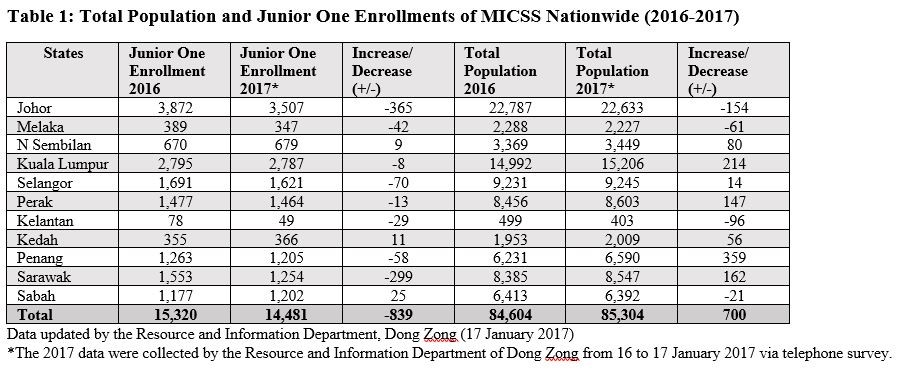
(1) This year (2017) the total population of all the Malaysian Independent Chinese Secondary Schools (henceforth MICSSs) reaches 85,304 and thus an increase of 700 students or an increasing scale of 0.82 percent in comparison to last year’s (2016) 84,604 students which was collected from all the MICSSs nationwide through questionnaire survey. It is also noted to be the 15 consecutive year’s growth in MICSS population since 2003.

(2) What is worthy of attention being, there is a decrease of 839 students or a decrease scale of 5.48 percent when the new enrollment for Junior One student in 2017 (n=14,481) is compared with that of 2016 (n=15,320, data collected in June survey) as shown in Table 1.

SY January 25, 2017 Statement1

Basic Statistics

(1) 2017 marks historical high within fifteen consecutive year’s growth in MICSS population

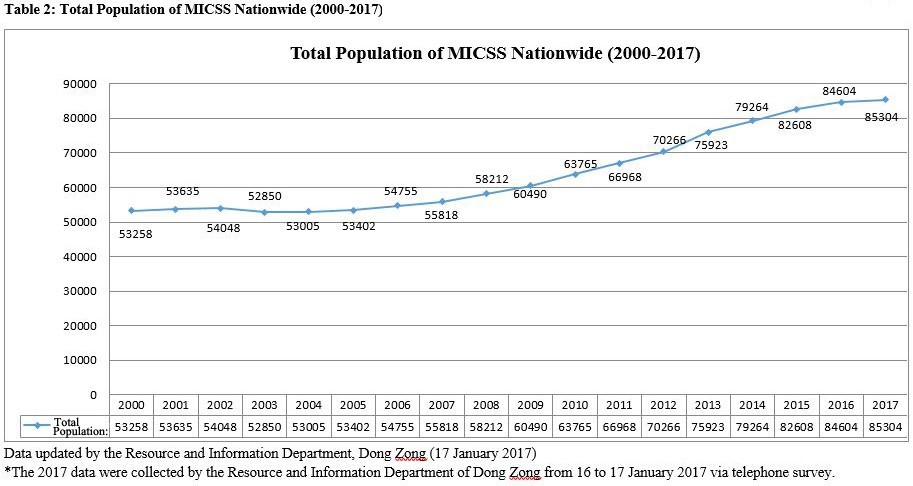
This year (2017), the total population of MICSS is 85,304 students which is the highest since the 1973 Chinese Education Resurgence and it is also the 15 consecutive year’s growth since 2003. In 2003, the total population of MICSS is 52,850 students, compared to this year’s 85,304 students, there is an increase of 32,454 students or an increasing scale of 61.41 percent over a 15-year span (Table 2).

SY January 25, 2017 Statement2

(2) Junior One Enrollments fall for four consecutive years

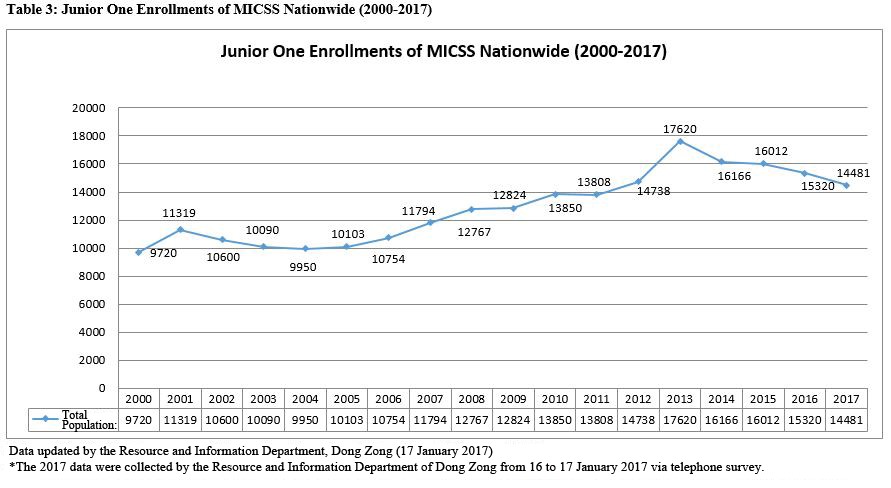
The total number of enrollments for MICSS Junior One nationwide this year is 14,481 students, thus a decrease of 839 in comparison to June 2016 survey and this shows a four consecutive years’ drop for Junior One enrollment nationally. Within the ten most decreased school in student number, Johor and Sarawak region are comparatively more prominent (7 schools), northern, central and eastern Malaysia each has one and the total decrease number is 701 which is equivalent to 83.55 percent of the total decrease. 2013 saw the highest Junior One enrollment nationally with 17,620 students only it plummets thereafter on a yearly basis. Figures show a drop from 17,620 enrollments in 2013 to 14,481 the following year, meaning a decrease of 3,139 students thus stands a decrease scale of 17.81 percent (Table 3).

SY January 25, 2017 Statement2

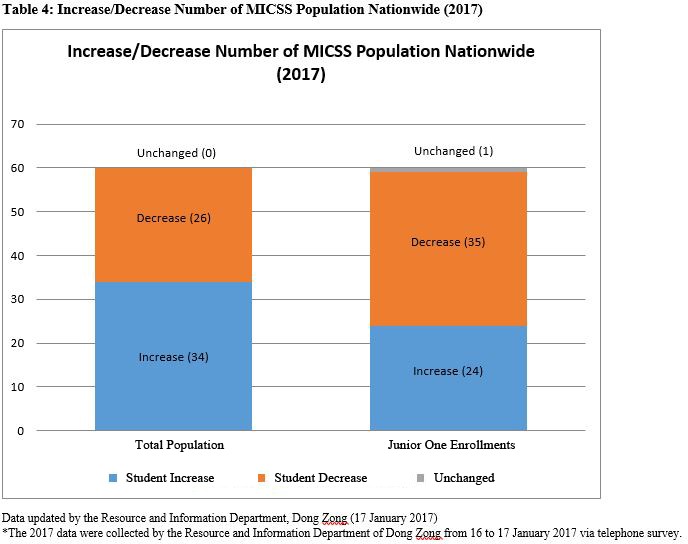
(3) On the total population of MICSS, data show an increase in 34 schools, whereas 26 schools decrease in number. As for Junior One enrollment, 24 schools increase, 35 schools decrease but only one school sustains in figure.

In terms of total MICSS population, compared with 2016, this year 34 schools increase which stands at 56.67 percent nationally; 26 schools decrease (grows from 25 schools in 2016 to 26 schools in 2017) which is 43.33 percent nationwide. Besides, for the number of Junior One enrollment, in comparison to 2016, there is increase in 24 schools or 40 percent nationally, 35 schools decrease (grows from 34 schools in 2016 to 35 schools in 2017) and thus stands at 58.33 percent and only one school sustains the number which is equivalent to 1.67 percent (Table 4).

SY January 25, 2017 Statement2

(4) 14 schools have less than 300 students nationwide in 2017

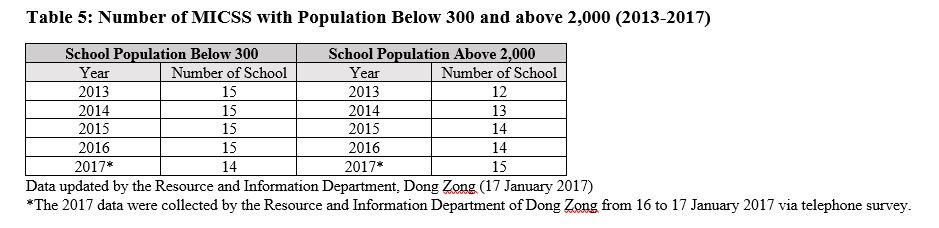
From 2015 to 2016, there are 15 schools which have less than 300 students for four consecutive years; whereas this year (2017) the number drops to 14 which is roughly one-fourth of all MICSSs (Table 5).

(5) 15 schools exceed 2,000 students nationwide in 2017

From 2015 to 2016, there is a record of 14 schools which exceed 2,000 students in population; this year (2017), the number increases from 14 to 15 which is one-fourth of all MICSSs (Table 5).

SY January 25, 2017 Statement2

Basic Analysis

(1) The drop in Junior One enrollment for four consecutive years is correlated to shortage of classrooms/space and intake decrease

Notwithstanding the number of Junior One enrollment decreases nationwide for four consecutive years, the total MICSS population remains unaffected but instead increases on a yearly basis. It is cautioned if the number of Junior One enrollment does not raise or sustain but drops continuously, the total population of all MICSSs will be affected tremendously. (Though it is likely when the Junior One enrollment drops year to year but the total number of the enrollment is comparatively more than drop-outs, the total population will increase.)

Preliminary judgement suggests that the cause of the decrease in Junior One enrollment nationally is correlated with over-intake of some large-scale MICSSs which actually results in the shortage of hardware and facilities as well as classrooms and space. When the student number saturates in these schools, cutting down intake will be the eventuality.

(2) Currently, the number of students of all MICSSs polarizes in distribution: it is over populated in urban schools and many students are denied in admission yet in rural area, the imbalance phenomena of student shortage and non-conformance Junior One enrollment are noted. Survey shows in 2017, the highest population of the large-scale MICSSs exceed 5,000 yet the lowest population of small-scale MICSSs is less than a hundred. The ten most populated schools (including branch schools) are as follows: 5 in Selangor state and Kuala Lumpur region, 3 in Johor state, 1 each in Negeri Sembilan and Sabah state and the total population of these schools is 41,177 or 48.28 percent of the total population nationwide. Yet the ten least student schools are all located in eastern Malaysia with a total population of 1,363 or 1.6 percent nationally. The figures strongly reveal the disparities and imbalance in terms of MICSS population nationwide.

Summary

In comparison to 2016, there is an increase of 700 students in the overall MICSS enrollment reaching 85,304 students which once again rewrote the highest record documented and sustains the longest ever increase record over the 15-year span since 2003. Yet, the increasing scale for the increased number shows a decrease from 2.42 percent in 2016 to 0.82 percent this year. On the other hand, the number of enrolled Junior One students this year when compared to 2016 reveals a decrease of 839 students, totals 14,481 students or a decrease scale of 5.48 percent (grows from 4.32 percent in 2016 to 5.48 percent), showing a four consecutive year’s decrease in Ju

UEC Holders Can Apply for CLP Examination— LPQB’s Decision Relieved Dong Zong  

Dong Jiao Zong Rebuts Muhyiddin’s View MICSS Curriculum Dovetails Malaysia’s Reality

Statement Released by Dong Zong

January 11, 2017

Dong Jiao Zong Rebuts Muhyiddin’s View

MICSS Curriculum Dovetails Malaysia’s Reality


With respect to the former Deputy Prime Minister cum Education Minister, the President of Parti Pribumi Bersatu Malaysia Tan Sri Muhyiddin bin Haji Muhammad Yassin’s claim that Dong Zong is extremist in attitude on the UEC official recognition issue and uncompromising in the amendment of MICSS curriculum as well as pointing out the MICSS History curriculum standard lacks national value and thus cannot meet the country’s inspiration and that being the reason why the UEC is hitherto unrecognised when interviewed by Chinese media, Dong Zong hereby responds as follows:


1. Dong Zong solemnly declares, Malaysia as a multiplicity nation, whether it was before or after independence for nearly sixty years now, multi-race, multi-culture and multi-religion is always her real and inherent nature. The acts to deny multiracial reality in nation founding and to destruct the abundant multicultural reality in social development hoping to impede national unity and advancement engaged by individuals or organisations in this multiracial, multicultural and multilingual characterised country treasured by many as legacy are essentially detrimental to advancement, national unity and integrity.


2. Dong Zong reiterates, the MICSS unified curriculum is formulated and designed attuned to the multiplicity reality of the country as well as the latest international secondary education curriculum standard. The MICSS unified curriculum, including the History subject, observes and adapts the national curriculum as blueprint in the process of formulation. Further, it also fully embodies localisation and pluralism, let alone the nurture of domestic and world view embedded. Patriotism is highlighted in the MICSS unified curriculum and competences like morality, intelligence, physical health, teamwork and aesthetics are focused to dovetail with the country’s multiplicity reality. In retrospect, the national History coursebooks which disarray our country’s multiplicity reality yet side a particular ethnic group and religion in a narrow minded and unitary historical view need to be redressed imminently by the government and Ministry of Education. As such, any assertion alleging that Dong Zong and MICSS unified curriculum are extremist and removed from the reality is nothing but smear and ignorant of the facts, if anything, topsy turvy.


Further, Dong Jiao Zong reckons Tan Sri Muhyiddin bin Haji Muhammad Yassin who had assumed the Deputy Prime Minister cum Education Minister indifferent to the country’s multiplicity nature and his related comments strongly supports his unitary mindset in the person of both a conformist and executor who in reality obstructs and destructs the country’s multiplicity development. That said, his preposterous allegation that Dong Zong is extremist in attitude on the UEC recognition issue and uncompromising in the amendment of MICSS unified curriculum is predictable.


3. Moreover, Dong Zong also wants to point out the UEC has been recognised and accepted by many top universities around the world, and the contributions independent Chinese secondary schools have made in producing polymaths for the country over the decades is undeniable. If what Tan Sri Muhyiddin bin Haji Muhammad Yassin has claimed rings true, viz., MICSS unified curriculum disarrays the national education principle, his decision is essentially inconsistent when he allowed UEC holders to enter teacher training college during his office as he highlighted in the media interview. Tan Sri Muhyiddin bin Haji Muhammad Yassin’s inconsistency in words and behaviours saliently indicates the government’s refusal to recognise the UEC formally has little to do with Dong Zong’s uncompromising stance in the MICSS curriculum amendment as well as its incongruence with the national education principle. Noting this, Dong Zong wishes all parties would review the UEC recognition issue from an educational and academic aspect but not political.


4. Dong Zong herewith posits, the fight for the UEC recognition formally has always been the expectation of the Chinese community; it is intended for the production and pooling of polymaths for the country auguring prosperity and national unity.  On the fight of the UEC official recognition, Dong Zong is neither supercilious nor obsequious and will argue on the basis of reason; rather, Dong Zong would not stoop to compromise for the UEC recognition if it were to abandon its stance in the safeguard of mother tongue education.


5. Dong Zong implores all political parties to discern that the UEC recognition has always been the wish of the Chinese community, thus sincerity and kindness is expected when approaching Dong Zong for dialogue and interaction for a speedy solution amenable to public needs. In the next impending election, all political parties are expected to mould an authentic democratic, open and equal multi-educational milieu. In the election manifesto, their decided stance whether to oppose or support the UEC recognition officially is greatly appreciated.